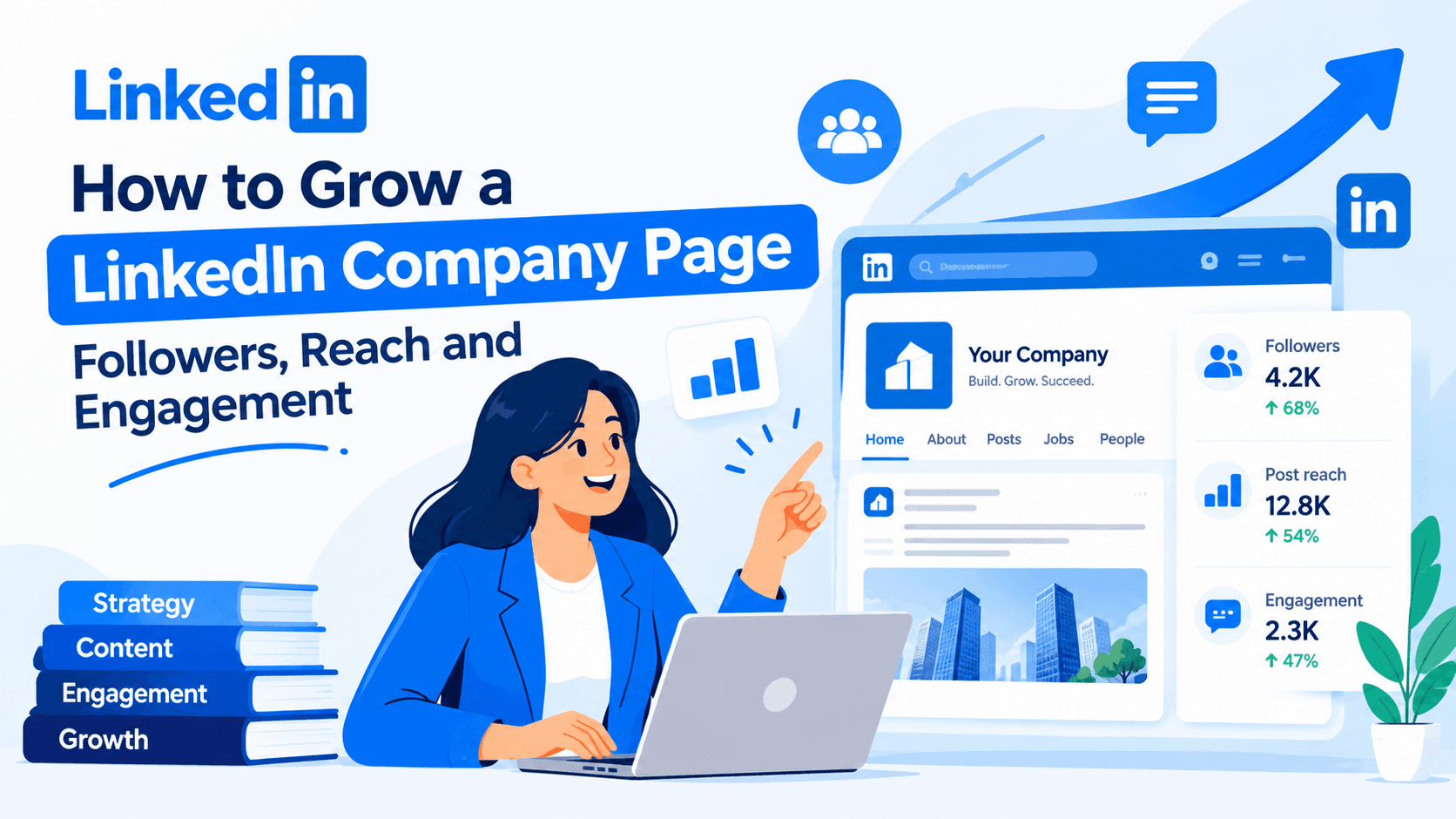
How to Grow a LinkedIn Company Page: Followers, Reach and Engagement
Growing a LinkedIn company page takes more than creating a profile and occasionally sharing company updates. Businesses need a clear content strategy, an optimized page, consistent publishing, and meaningful interactions with their target audience.
Whether you run a startup, an established business, a B2B company, or a digital marketing agency, LinkedIn can help you build brand awareness, share industry knowledge, attract potential customers, and develop professional relationships.
However, a large follower count alone does not guarantee business growth. Focus on attracting people who are genuinely interested in your company's products, services, expertise, or industry.
In this guide, you will learn how to grow a LinkedIn company page, increase relevant followers, improve content engagement, and measure your progress with practical strategies.
Why LinkedIn Company Page Growth Matters
A LinkedIn company page gives your business a dedicated presence on a professional networking platform. It allows potential customers, employees, partners, and industry professionals to learn about your organization.
A well-maintained page can support several business objectives.
Brand awareness: Regularly publishing useful content helps more people discover your company and understand what it does.
Professional credibility: Sharing practical insights, company updates, and industry knowledge helps visitors better understand your expertise.
Audience development: A relevant follower base provides an audience for your announcements, educational posts, product updates, and other company content.
Lead generation: Useful content can encourage potential customers to explore your website, learn about your services, or contact your business.
Recruitment and employer branding: A company page can help prospective employees understand your organization's culture, activities, and opportunities.
These benefits depend on the quality and relevance of your content. Growing an audience that matches your business goals is generally more useful than pursuing follower numbers alone.
1. Optimize Your LinkedIn Company Page
Before focusing on follower growth, make sure your LinkedIn company page gives visitors a clear reason to learn more about your business.
Use a recognizable company logo
Upload a clean, high-resolution company logo that remains readable at small sizes. Use consistent branding across LinkedIn and your other online channels so people can recognize your business easily.
Write a clear company description
Explain what your business does, whom it serves, and what makes its products or services relevant.
Avoid vague descriptions filled with generic marketing language. A visitor should be able to understand your offering without reading several paragraphs.
For example, a digital marketing company might explain the industries it serves, the services it offers, and the specific business problems it helps address.
Complete the important profile details
Keep the available company information accurate and up to date. Depending on your business, this may include:
Company website
Industry and organization type
Company size
Location
About section
Relevant specialties
Use a suitable cover image that supports your branding and communicates your company's focus.
Add a clear next step
Where appropriate, make it easy for visitors to explore your website, learn about your services, or contact your team.
An optimized company page creates a stronger first impression and builds confidence in the organization behind the content.
2. Publish Valuable Content Consistently
One of the most practical ways to grow a LinkedIn company page is to publish content that helps your target audience solve real problems.
Instead of using your page only for promotional announcements, create a balanced content strategy.
Share educational content
Explain common challenges in your industry, provide actionable advice, and answer questions your potential customers frequently ask.
For example, a digital marketing business could publish guides about content planning, campaign measurement, customer acquisition, and social media performance.
Educational posts give people a reason to follow your page even when they aren't actively looking to buy.
Publish company updates
Share relevant announcements about new services, product improvements, team achievements, events, or business milestones.
Make sure each update provides useful context rather than simply announcing that something happened.
Use examples and original insights
Practical examples can make your content more valuable than generic advice.
Consider publishing a breakdown of a business problem, a lesson learned from a project, or an explanation of how a particular process works. Use real evidence where available and obtain permission before sharing confidential client information.
Experiment with different content formats
Depending on your audience and resources, try text posts, document posts, infographics, short videos, and links to useful resources.
Observe which formats generate relevant conversations, clicks, and other meaningful results. Do not assume one format will perform best for every industry.
Develop a realistic publishing schedule
Choose a schedule that your team can maintain. For example, begin with two or three well-prepared posts per week, then adjust according to your capacity and results.
Consistency is more useful than publishing frequently for a short period and then abandoning the page.
3. Attract Relevant LinkedIn Page Followers
Follower growth matters most when followers genuinely care about your content or offerings.
Invite relevant professional contacts
Use LinkedIn's available company-page invitation features to invite appropriate contacts to follow your page, subject to the platform's current limits and eligibility requirements.
Prioritize people who understand your industry, work in relevant roles, or may find your content useful.
Encourage employees to engage
Your team members can help make company content more discoverable by sharing relevant updates with their professional networks.
Encourage employees to participate voluntarily, contribute their own perspectives, and share content that genuinely interests them.
Authentic participation is preferable to asking everyone to post identical comments or repetitive promotional messages.
Promote your company page across existing channels
Include your LinkedIn presence in suitable places, such as your company website, email newsletter, business presentations, or other professional social profiles.
When appropriate, explain what followers can expect from your page, such as practical industry advice, company news, product updates, or educational resources.
Participate in relevant discussions
Follow relevant industry topics, engage thoughtfully with professional discussions, and contribute useful information when your business has something valuable to add.
Avoid irrelevant comments or repetitive promotional replies. The purpose is to build recognition by contributing to conversations that matter to your audience.
4. Improve LinkedIn Post Reach and Engagement
Publishing content is only one part of the process. You also need to understand whether people find it useful.
Write clear and relevant opening lines
The opening of a post should quickly tell readers what the content is about and why it matters.
Instead of beginning with a generic announcement, introduce a specific challenge, useful observation, question, or lesson.
For example, a post about company-page growth could start by explaining a common mistake businesses make when measuring social media performance.
Make content easy to read
Use short paragraphs, clear wording, and a logical structure. Break down complex ideas into practical steps where appropriate.
Visuals can support your message, but they should improve understanding rather than serve as decoration alone.
Encourage meaningful conversations
Ask relevant questions when you genuinely want to hear the audience's opinions. Respond thoughtfully to comments and address questions that arise from your posts.
Avoid engagement bait, misleading claims, or requests for interactions that provide no value to readers.
Analyze your stronger posts
Review the posts that attract meaningful engagement, profile visits, website clicks, or business inquiries.
Look for patterns in their topics, formats, presentation, and audience relevance. Use these observations to improve future content.
Remember that impressions, reactions, comments, clicks, and conversions measure different things. High engagement on one post does not automatically mean it generated business results.
5. Encourage Employees to Support Your Company Page
Employees can boost company-page visibility because they bring their own professional experience, knowledge, and networks.
However, employee advocacy works best when participation is authentic.
Provide your team with relevant updates, useful resources, and clear information about the company's products or services. Let employees decide what they want to share in their own voice.
You can also invite subject-matter experts within your organization to contribute educational posts, explain industry developments, or answer common customer questions.
For example, a software company might ask a product specialist to explain a common technical challenge, while a consulting firm might share practical insights from its area of expertise.
Avoid requiring employees to copy and paste identical promotional messages. Original contributions are more likely to communicate genuine expertise and create useful discussions.
6. Use LinkedIn Analytics to Measure Growth
To improve your LinkedIn company page strategy, measure performance consistently rather than relying only on the total number of followers.
Review the analytics available to your page administrators and focus on metrics that align with your business goals.
Follower growth
Monitor how your follower count changes over time. Where reporting is available, review relevant audience information to assess whether the page is reaching the professional groups you want to attract.
Impressions and reach
Impressions indicate how often content is displayed. Reach and unique-viewer measurements, where available, represent different aspects of content exposure.
Check the definitions used in your analytics before comparing metrics.
Engagement
Review available reactions, comments, reposts, and other engagement metrics. Look beyond totals to understand whether the interactions relate to your audience and objectives.
Website clicks and conversions
When your goal is website traffic or lead generation, measure the clicks and resulting actions that matter to your business. Analytics tools and properly configured campaign tracking can help connect social activity with website outcomes.
Create a monthly review
At the end of each month, identify:
Which posts performed best against your objectives
Which topics attracted the most relevant audience
Whether follower growth is moving in the desired direction
Which content generated useful conversations or website visits
What you should test or improve next month
Use the results to refine your strategy. Do not rely on a single post or a short measurement period to judge the entire page.
7. Common LinkedIn Company Page Growth Mistakes
Businesses can spend considerable time publishing content without making meaningful progress if they overlook a few common problems.
Posting only promotional material
Constantly advertising products or services gives people little reason to follow your page between purchasing decisions.
Balance promotional updates with educational content, useful insights, company expertise, and relevant industry news.
Ignoring audience relevance
A large follower count isn't necessarily valuable if those people have little interest in your business.
Prioritize reaching relevant professionals and organizations rather than measuring success solely by follower count.
Publishing inconsistently
Long gaps between posts can make a page appear inactive. Create a manageable schedule and maintain it with content your team can realistically produce.
Ignoring comments and questions
When people engage with your company, unanswered questions can represent missed opportunities to build relationships.
Respond where appropriate and use recurring questions to identify topics for future posts.
Buying engagement without understanding the risks
Some providers advertise paid follower, connection, or engagement services. Before using any such service, carefully review how it operates, what it delivers, and whether it complies with LinkedIn's current terms and policies.
Artificial or inauthentic engagement can distort your performance measurements and may expose your organization or accounts to platform enforcement risks. No third-party provider can legitimately guarantee that an account is risk-free.
A sustainable company-page strategy should prioritize relevant audiences, useful content, genuine professional interactions, and measurable business outcomes.
How Long Does It Take to Grow a LinkedIn Company Page?
There is no fixed timeline for growing a LinkedIn company page. Results depend on factors such as your existing network, industry, audience size, content quality, publishing consistency, and how much genuine attention your business can attract.
A new company page may need time to establish its identity and discover which content resonates with its audience. An established business may already have customers, employees, and professional contacts who can help introduce the page to relevant people.
Rather than expecting a specific number of new followers every week, set realistic objectives and review your performance monthly.
Track your starting point, publish consistently, experiment with useful content, and refine your approach using evidence. This makes it easier to distinguish meaningful growth from temporary fluctuations.
How LinkedIn Growth Services Fit Into Your Strategy
Businesses exploring ways to manage their social media presence may also research external LinkedIn growth services and SMM panels.
An SMM panel can list different social media services through a centralized interface. However, services, delivery methods, quality, and terms vary by provider, so evaluate each option carefully.
If you are researching options, you can review LinkedIn SMM Panel services at EasyToPromo.
Before selecting a service, check its description, pricing, delivery expectations, refund terms, and relevant platform-policy considerations. Do not assume that purchased followers or engagement are necessarily genuine, that they will remain over time, or that they will produce leads and sales.
For long-term company-page growth, base your strategy on relevant content, audience understanding, and performance measurement.
Frequently Asked Questions
1. How do I get more followers on my LinkedIn company page?
Optimize your company profile, publish useful content consistently, invite relevant professional contacts using available page features, encourage voluntary employee advocacy, and participate in relevant industry discussions. Review your analytics to determine which activities attract the right audience.
2. How often should a company post on LinkedIn?
Start with a realistic schedule that your team can maintain, such as two or three useful posts per week. Adjust the frequency based on your resources, audience response, and content quality, not just to meet a quota.
3. Can a small business grow on LinkedIn?
Yes. Small businesses can use LinkedIn to share their expertise, explain their offerings, participate in industry conversations, and build professional relationships. A focused, relevant audience can be more useful than a large but unrelated following.
4. How can I measure LinkedIn company page engagement?
Review the engagement metrics available to your page, such as reactions, comments, reposts, and other reported interactions. Compare them with impressions and relevant outcomes such as website visits or inquiries. Always check how each metric is defined before making comparisons.
5. Do LinkedIn company page followers help with business growth?
Followers can help your content reach an audience interested in your organization. However, follower count alone does not guarantee visibility for every post, customer inquiries, or sales. Audience relevance and content usefulness also matter.
6. Is it better to focus on followers or engagement?
Both can provide useful information, but they measure different things. Follower growth helps you understand audience growth, while engagement shows how people respond to your content. Choose metrics according to your business objectives and evaluate them together.
7. Can I use an SMM panel for LinkedIn growth?
Some SMM panels advertise LinkedIn-related services, but their methods and risks vary. Review the provider's terms carefully and ensure that your approach complies with LinkedIn's current policies. Do not assume a service is safe or effective based solely on its marketing claims.
Conclusion
Growing a LinkedIn company page requires a clear strategy, consistent content, and a focus on the professionals you want to reach.
Start by optimizing your page, publishing useful insights, building relevant professional relationships, and encouraging authentic engagement. Measure your progress with the analytics available to you, then improve your strategy based on the results.
Avoid judging success solely by your follower count. A smaller audience that trusts your company and engages with your content can be more valuable than a larger audience with little genuine interest.
With a sustainable publishing routine and a commitment to providing value, your LinkedIn company page can become a useful part of your broader brand-awareness, networking, and business-development strategy.